
Grool
Grool is informal sexual slang for vaginal lubrication associated with sexual arousal. Expressions such as pussy grool refer to the same sexual wetness.[1]
In adult use, grool often refers especially to clearly visible or abundant sexual wetness.
Grool is not one special medical fluid. During sexual arousal, increased genital blood flow causes fluid derived from blood plasma to pass through the vaginal wall, producing natural lubrication.[2] Visible wetness can also mix with cervical mucus and other normal genital secretions, which helps explain why its amount and consistency can vary.
What grool is
Why is it called grool?

In its sexual meaning, grool is commonly explained as a blend of girl and drool.[1] The name compares abundant genital wetness with drool or saliva and is descriptive adult slang rather than an anatomical term.
The same word also has an unrelated popular-culture meaning. In Mean Girls, grool is used as an accidental combination of great and cool.[3] The sexual meaning discussed on this page is different.
How is the term grool used?

In adult slang, grool is used as a noun for visible sexual wetness. It commonly appears in combinations such as pussy grool, grool porn and girl drool, especially in adult-media titles, tags, searches and informal discussion.
The word is often used when the wetness is visually noticeable — for example when fluid coats the vulva, stretches into strings or transfers onto fingers, a penis or a sex toy. This usage is broader and less medically precise than terms such as vaginal lubrication or arousal fluid.
An illustrative use would be: Her pussy was covered in grool. In that sentence, grool means visible genital wetness rather than squirting.
Because grool is informal slang, different users may apply it somewhat differently. The surrounding context is therefore more useful than treating the word as a precisely defined medical category.
Where does grool come from?
This process is called vaginal transudation. As genital blood flow increases during arousal, fluid passes through the vaginal wall and contributes to the moisture that eventually spreads around the vaginal opening and vulva.[2]
Visible wetness can also contain cervical mucus and other genital secretions. What is casually called grool is therefore not necessarily one chemically uniform fluid.
What does grool look like?
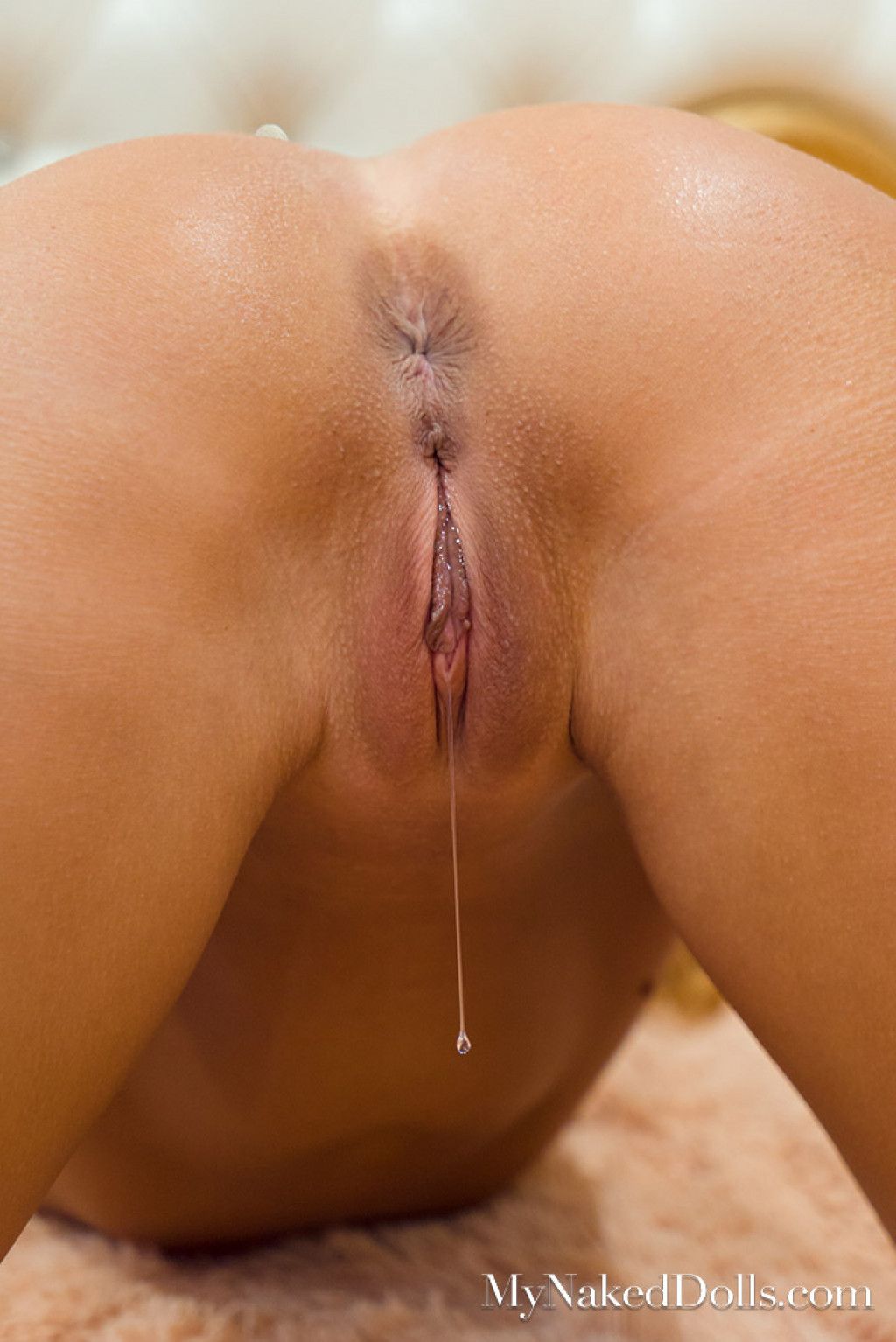
Grool is commonly seen as clear, translucent or whitish moisture covering the inner labia and vaginal opening. When there is more fluid, it may coat fingers, sex toys or a penis and can sometimes form visible strings between two surfaces.
There is no medical test or precise appearance that defines something as "grool". It is a slang description of visible sexual wetness rather than a separate type of body fluid.
Why can grool be stringy?
Some genital fluids are naturally more slippery or stretchy than others. Cervical mucus becomes particularly thin, slippery and stretchy around ovulation and can mix with other vaginal fluids.[5]
This means that a long string of fluid seen coming from a pussy does not by itself reveal exactly where the fluid came from.
Grool and sexual arousal

Sexual stimulation can measurably increase vaginal lubrication. Laboratory studies have detected increased lubrication when women viewed sexual material, together with increased genital blood flow.[6]
A woman may produce very little visible grool during one sexual experience and much more during another. There is no well-established amount that a woman is supposed to produce.
Can grool appear without genital touching?
Yes. Vaginal lubrication can increase in response to sexual stimuli even without direct genital touching. In a laboratory study of 36 women, researchers measured lubrication while participants viewed nonsexual and sexual material. High-intensity sexual stimuli produced significantly more lubrication than nonsexual stimuli.[6]
This means that physical touching of the pussy is not required for the lubrication response to begin. Visual sexual material, sexual thoughts or another source of arousal can be accompanied by genital wetness, although the amount varies greatly between women and situations.
How wet can a woman get?
There is no well-established normal or maximum volume of arousal lubrication during ordinary sexual activity. Research shows that the amount varies, but laboratory studies often measure changes in wetness rather than collecting and measuring the total fluid volume.[6]
Anecdotal reports include women becoming wet enough during arousal to soak underwear and sometimes leave visible moisture through trousers. This demonstrates that very abundant wetness can occur, but it does not tell us how common it is.[7]
Can a woman be aroused without much grool?
Yes. A woman can feel strongly sexually aroused while producing relatively little visible lubrication. Subjective sexual arousal and genital response are related, but they do not always rise and fall together.
A meta-analysis of 132 laboratory studies involving 2,505 women found an average correlation of only r = .26 between women's subjective and measured genital arousal.[8] The studies measured genital response more broadly rather than grool specifically, so this does not give an exact relationship between conscious arousal and the amount of visible lubrication.
Lubrication can also be affected by factors unrelated to how much a woman wants sex. Lower estrogen levels can reduce vaginal moisture, and some medications, including certain antidepressants and cold or allergy medicines, can contribute to vaginal dryness.[9]
For a partner, the practical conclusion works in both directions: a very wet pussy does not prove strong desire, and a relatively dry pussy does not prove lack of desire.
Wetness does not necessarily mean desire
Physical genital arousal and consciously felt sexual arousal do not always match. A meta-analysis of 132 laboratory studies involving 2,505 women and 1,918 men found an average correlation of r = .26 between women's subjective and measured genital arousal, compared with r = .66 in men.[8]
The study measured genital arousal more broadly rather than grool specifically, but it shows why visible wetness should not be treated as proof of desire, attraction or consent.
Grool and other genital fluids
Grool is not the same as normal vaginal discharge
The vagina normally contains moisture even when a woman is not sexually aroused. Normal vaginal discharge is usually clear to white, and its amount and consistency can change throughout the menstrual cycle.[10]
In its narrower sexual meaning, grool refers specifically to wetness associated with sexual arousal rather than every fluid normally found around the vaginal opening.
Grool is not squirting
Grool and squirting are different phenomena. Arousal lubrication mainly accumulates inside the vagina and around the vaginal opening, while squirting is fluid expelled through the urethra.
A review of female sexual fluids describes vaginal lubrication primarily as transvaginal fluid derived from blood plasma, while squirting fluid is largely diluted urine from the bladder.[11]
Grool is not female ejaculation
Female ejaculation is also different. It usually refers to a small amount of thicker, whitish fluid released from the female prostate (Skene's glands), often around orgasm.[11]
A woman can therefore become heavily lubricated without squirting or ejaculating, and she can potentially experience these phenomena together during the same sexual activity.
Grool during sex
Natural lubrication can spread over the vaginal opening, labia, penis, fingers or sex toys during sexual activity.
In photographs and videos, however, the source of visible fluid cannot reliably be identified from appearance alone. Clear or stringy moisture may include natural lubrication, cervical mucus, other genital fluids or artificial lubricant.
What does grool feel like to touch?

Grool usually makes the inner vulvar surfaces feel wet, slick and slippery. On the fingers, penis or a sex toy, it can reduce the amount of friction compared with touching relatively dry genital tissue.[2]
The texture is not always identical. More watery lubrication may feel thin and spread easily across the skin, while fluid mixed with stretchy cervical mucus can feel more viscous or stringy and may stretch between the fingers, labia, penis or toy.[5]
A large amount can make several surfaces feel wet at once, including the inner labia, vaginal opening and nearby skin. This is one reason abundant grool can be much more noticeable during actual touching than it appears in a still photograph.
What may a partner notice?

A partner may notice grool by touch before seeing it clearly. Increasing lubrication can make fingers or a penis slide more easily across the vulva or vaginal opening, while wetness transferred onto the skin can make the change obvious even when there is no visible dripping.
When there is more fluid, a partner may see it coat the inner labia, collect near the vaginal opening, transfer onto a penis or fingers, or form thin strings as two wet surfaces separate.
One potentially unexpected feature is how quickly the amount can change. A pussy that initially feels only slightly moist can become considerably more slippery as sexual stimulation continues.[6]
The amount a partner sees or feels should not be interpreted as a direct measurement of the woman's mental state. As explained above, genital wetness and consciously felt sexual arousal do not always correspond closely.[8]
What does grool taste like?

There is no single taste of grool. Scientific research has described the composition and acidity of vaginal fluids much better than their perceived taste, so there is no established medical scale for how vaginal lubrication is supposed to taste.
Normal vaginal fluid in women of reproductive age is usually moderately acidic, commonly around pH 3.8–5.0. Lactic acid produced within the vaginal environment contributes substantially to this acidity.[12]
For this reason, natural genital wetness may be perceived as mildly tangy or slightly sour. Vaginal and cervical fluids also contain water, proteins, lipids and dissolved ions, so a partner may perceive other mild qualities, including a slightly salty or mineral-like taste.[13]
These descriptions should be understood as practical sensory descriptions rather than precise scientific categories. The taste can vary because the fluid present around the vulva during sex is usually a mixture rather than pure vaginal transudate. It may include cervical mucus, ordinary vaginal secretions, vulvar moisture and sweat, as well as lubricant, semen or other fluids if they are present.[13]
During cunnilingus, this means that a partner is usually tasting the combined moisture covering the vulva and vaginal opening rather than one chemically uniform substance. Its taste can therefore differ between women and can also change in the same woman at different times.
Taste and smell are also closely experienced together during oral sex. Research on genital preferences has found that both men and women spontaneously mention the taste and smell of female genital wetness when describing what they like about women's genitals, although such studies do not establish one typical flavor.[14]
Related adult search terms
Related adult search terms include:
- pussy grool
- grool pussy
- grool porn
- pussy grool porn
- girl drool
- wet pussy
- wet pussy porn
- pussy juice
- girl juice
- girl goo
- vaginal lubrication
- arousal fluid
See also
References
- ↑ 1,1 1,2 Wiktionary contributors. grool. Wiktionary. Wiktionary
- ↑ 2,1 2,2 2,3 Levin R. J. The physiology of sexual arousal in the human female: a recreational and procreational synthesis. Archives of Sexual Behavior, 2002. PubMed
- ↑ Playbill. Mean Girls Defines All the Fetch Schquillz for You. 2018. Playbill
- ↑ Richiex. Female sexual arousal.JPG, 2009. Wikimedia Commons. CC BY-SA 3.0. Source: Wikimedia Commons License: CC BY-SA 3.0.
- ↑ 5,1 5,2 American College of Obstetricians and Gynecologists. Trying to Get Pregnant? Here's When to Have Sex. ACOG
- ↑ 6,1 6,2 6,3 6,4 Bouchard K. N. et al. Concurrent measurement of genital lubrication and blood flow during sexual arousal. Biological Psychology, 2019. PubMed
- ↑ Anonymous discussion. How Wet is Normal? Reddit, r/sexeducation, 2022. Reddit
- ↑ 8,1 8,2 8,3 Chivers M. L., Seto M. C., Lalumière M. L., Laan E., Grimbos T. Agreement of self-reported and genital measures of sexual arousal in men and women: a meta-analysis. Archives of Sexual Behavior, 2010. PubMed
- ↑ American College of Obstetricians and Gynecologists. Experiencing Vaginal Dryness? Here's What You Need to Know. ACOG
- ↑ American College of Obstetricians and Gynecologists. Vulvovaginal Health. ACOG
- ↑ 11,1 11,2 Pastor Z., Chmel R. Differential diagnostics of female "sexual" fluids: a narrative review. International Urogynecology Journal, 2018. PubMed
- ↑ Lin YP, et al. Vaginal pH Value for Clinical Diagnosis and Treatment of Common Vaginitis. Diagnostics, 2021. PubMed Central
- ↑ 13,1 13,2 Hickey DK, et al. Mutual Preservation: A Review of Interactions Between Cervicovaginal Mucus and Microbiota. Frontiers in Cellular and Infection Microbiology, 2021. PubMed Central
- ↑ Schick VR, et al. In their own words: a qualitative content analysis of women’s and men’s preferences for women’s genitals. Sex Education, 2016. PubMed Central
