
How to Squirt
Learning how to squirt means exploring whether this sexual response occurs for you, rather than following a method that works for everyone. Research describes several routes to squirting, with differences in preferred stimulation, circumstances and feelings about the experience.[1][2]
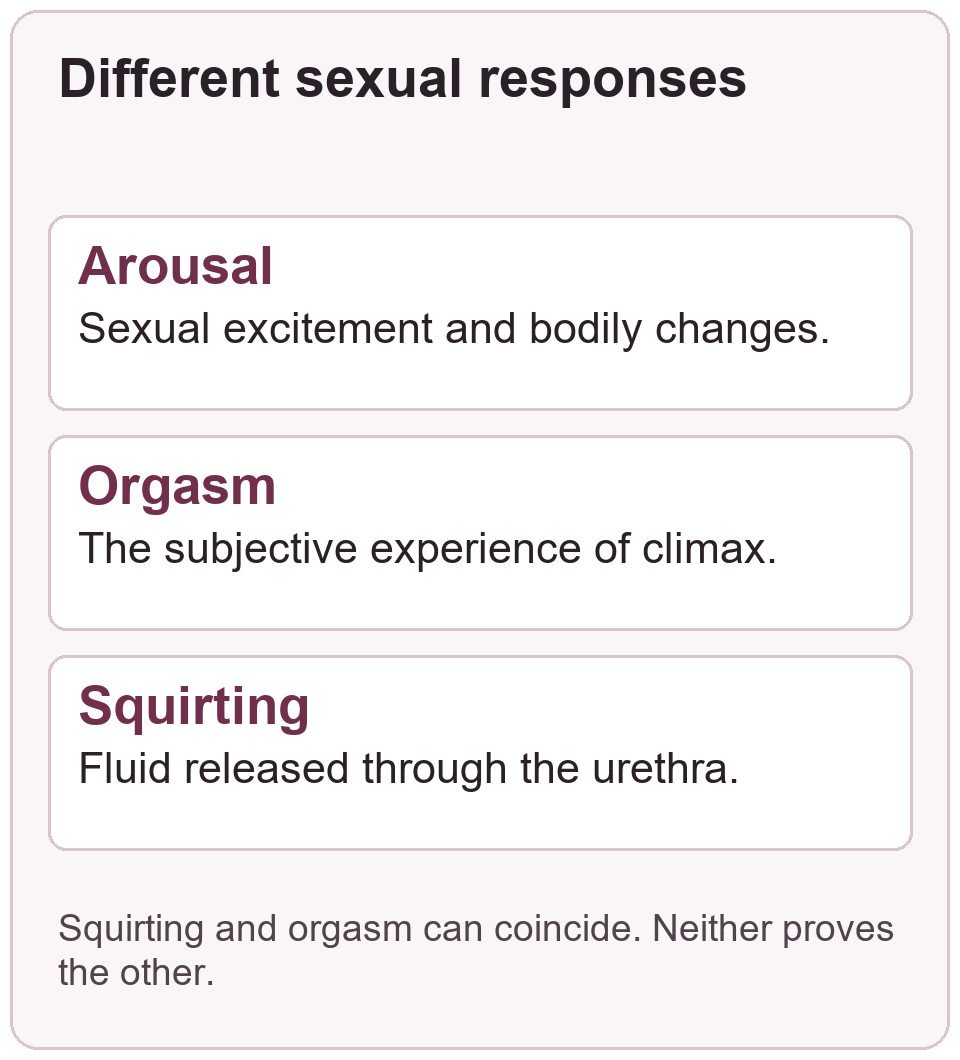
This guide addresses practical questions for the person exploring squirting and for a partner. The main Squirting article explains the fluid's origin, terminology and relationship to other sexual responses.
Start with realistic expectations
There is no proven technique that reliably makes every woman squirt. Reports of successful techniques describe what worked for particular participants; they do not establish a universal training program.[2]
The distinction between discovery and learning matters. In a U.S. probability survey, around two thirds of women who had squirted described discovering it unintentionally, while many subsequently used deliberate techniques. This does not show that everyone who has never squirted will be able to learn it.[1]
Decide whether squirting is something you want to explore, rather than treating it as a requirement. Interviews with young adult women describe varied emotional responses and highlight the importance of communication and a partner's reaction.[3]
Exploring your own response
Begin with enough stimulation to reach strong sexual arousal rather than treating squirting as an immediate mechanical response. In the U.S. probability study, 75.6% of women who had squirted reported using some deliberate technique rather than experiencing it only spontaneously.[1]
The reported ways of building toward squirting were diverse. In that study, 19.6% reported harder or more intense touch, 16.9% preparation and warm-up, 16.5% pressure against the vaginal wall, 15.6% clitoral stimulation alone and 12.5% simultaneous pressure from inside and outside.[1]
Experimenting with clitoral and vaginal stimulation separately and together is therefore more consistent with the evidence than assuming there is one mandatory "G-spot technique". The newer 2026 study similarly found multiple pathways, although anterior vaginal-wall stimulation appeared frequently in women's descriptions.[2]
If an urge resembling urination appears during intense stimulation, it can be part of the build-up reported by some women.[3] It does not guarantee that squirting will happen, and a woman does not need to force the response.
Some women prefer to urinate before sexual activity because it makes the sensation less confusing or reduces worry about ordinary urination. Interestingly, the small ultrasound study found that the bladder could refill substantially during sexual arousal even after it had initially been emptied.[4]
With a partner
A partner can experiment with steady vaginal-wall stimulation, clitoral stimulation or a combination while following the woman's feedback. Research does not support the idea that progressively harder or faster stimulation is universally required.[1][2]
If a particular rhythm or pressure is producing a strong pleasurable build-up, keeping that pattern consistent may be more useful than repeatedly changing technique. Some women describe firm rhythmic stimulation of the anterior vaginal wall, but others squirt through completely different forms of stimulation.[2]
The response should not become a performance target. A 2026 qualitative study found that some women experienced partners treating squirting as proof of sexual skill or pressuring them to reproduce it, even when that interpretation did not match the woman's own experience.[5]
Common questions
Does squirting mean you had an orgasm?
Not necessarily. Squirting and orgasm may occur together, but they are not interchangeable. In the U.S. survey, only a minority of women who had squirted reported always experiencing the two together.[1]
An orgasm without a visible fluid release should not be treated as an unsuccessful attempt. The goal can remain an enjoyable experience even if squirting does not happen.
Does an urge to urinate mean squirting is about to happen?
An urge or feeling of pressure can be part of the build-up some women describe, but it is not a dependable signal. A sensation by itself cannot tell you whether fluid release will follow.[3]
The underlying physiology and the distinction from female ejaculation are explained in Squirting.
Is there a required number of attempts?
The research cited here does not establish a fixed number of sessions, a deadline or a progression everyone should follow. Survey reports and qualitative interviews are not trials of a guaranteed learning protocol.[1][2]
See also
References
- ↑ 1,1 1,2 1,3 1,4 1,5 1,6 1,7 1,8 Hensel DJ, von Hippel CD, Lapage CC, Perkins RH. Vaginal Squirting: Experiences, Discoveries, and Strategies in a U.S. Probability Sample of Women Ages 18-93. The Journal of Sex Research, 2024. PubMed
- ↑ 2,1 2,2 2,3 2,4 2,5 2,6 Påfs J, Törnbom K, Wahlberg A. “It’s About Building Up an Intense Arousal That Eventually Explodes”: Results of an Online Survey in Sweden Exploring Cis-Women’s Squirting Techniques. International Journal of Sexual Health, 2026. Taylor & Francis
- ↑ 3,1 3,2 3,3 Cutillas-Blasco S, Ruiz-Gonzalez C, Rueda-Ruzafa L, et al. Experiences of young women in the practice of squirting: a descriptive qualitative study. The Journal of Sexual Medicine, 2024. PubMed
- ↑ Salama S, Boitrelle F, Gauquelin A, et al. Nature and origin of "squirting" in female sexuality. The Journal of Sexual Medicine, 2015. PubMed
- ↑ Påfs J. Squirting Scripts: Navigating Validation, Avoidance, Desire, and Coercion in Sexual Encounters Between Women and Men. Archives of Sexual Behavior, 2026. PubMed