
Inner Labia
Inner labia, also called the labia minora or inner pussy lips, are the two soft folds of tissue inside the outer labia. They are part of the vulva and surround the central area containing the urethral and vaginal openings. Their size, shape, color and visibility differ greatly between women.[1]
Obsah
- 1 Where are the inner labia?
- 2 What are the inner labia for?
- 3 Inner labia can be hidden or visible
- 4 Inner labia size varies greatly
- 5 The two inner labia do not have to match
- 6 Color and texture vary too
- 7 What do inner labia feel like to touch?
- 8 Inner labia during sexual arousal
- 9 Inner labia can be sexually sensitive
- 10 Can sex make the inner labia larger?
- 11 Can large inner labia cause problems?
- 12 Labiaplasty
- 13 References
Where are the inner labia?
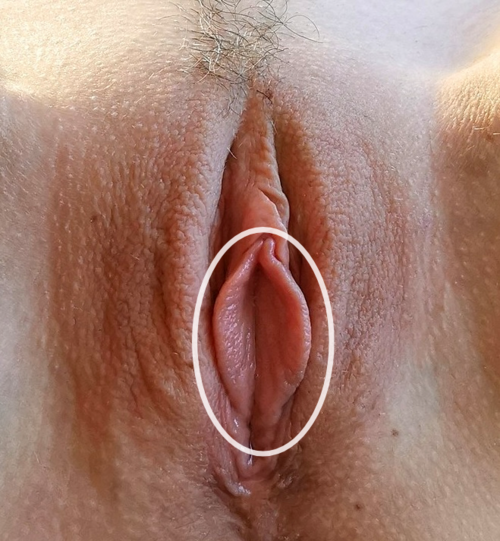
The inner labia lie inside the outer labia, one on each side of the central part of the vulva. They extend from the clitoral area at the top down along the sides of the urethral and vaginal openings.
They do not normally grow pubic hair, which makes them relatively easy to distinguish from the surrounding outer genital area.
What are the inner labia for?
The inner labia help surround and protect the more delicate central parts of the vulva. They also contain many blood vessels and nerve structures and take part in the female sexual response.[3]
Inner labia can be hidden or visible
Some women have inner labia that remain almost completely hidden between the outer labia. In others, they extend beyond the outer folds and are clearly visible even when the pussy is naturally closed.
In a Danish study of 244 women, 56% had visible inner labia. This means that having inner lips that protrude outside the outer lips is very common and not by itself abnormal.[4]
Inner labia size varies greatly
There is no single normal size for inner labia. A 2026 systematic review identified seven studies involving 991 women. Three studies involving 307 women contained sufficient data for meta-analysis, producing a pooled mean labia minora length of 53.23 mm and width of 18.28 mm. The studies nevertheless differed substantially from one another, showing that a single average does not describe the full range of normal anatomy.[1]
An earlier review of ten anatomical studies found reported labial lengths ranging from 5 to 100 mm and widths from 1 to 60 mm.[5]
These ranges come from different studies using somewhat different populations and measurement methods, so they should not be interpreted as precise lower and upper boundaries of a "normal" labium.
The two inner labia do not have to match
The left and right inner labia can differ in length, width or shape. Asymmetry is common and does not mean that something is wrong.[5]
One side may therefore hang noticeably farther outside the pussy than the other.
Color and texture vary too
Inner labia can be smooth or visibly wrinkled. In a study of 50 healthy premenopausal women, labial rugosity was rated as smooth in 14 women, moderate in 34 and marked in 2.[6]
Color also varies. In the same study, the genital area was darker than the surrounding skin in 41 of 50 women and the same color in 9.[6]
Pigmentation can be especially noticeable along the edges of the inner labia, so darker labial margins can be part of normal anatomy.[1]
What do inner labia feel like to touch?
The inner labia do not feel like smaller versions of the padded outer lips. Unlike the outer labia, they contain little or no fatty tissue. Their core consists mainly of connective tissue with collagen, elastic fibers, blood vessels and nerve structures.[3][7]
To the fingers, this means that inner labia generally feel thin, soft, flexible and easy to fold or move, rather than thick or cushion-like. A larger inner labium may feel like a substantial soft flap of tissue, while a very small one may feel more like a narrow flexible ridge.
Their surface is not necessarily perfectly smooth. As described above, some inner labia are smooth while others have obvious folds and wrinkles, so a finger may feel anything from a relatively even surface to a distinctly ridged or crinkled texture.[6]
Moisture also changes the sensation considerably. When vaginal secretions or sexual lubrication coat the inner labia, their surfaces can become slippery and slide easily against each other and against the fingers. The underlying tissue remains flexible rather than becoming hard.
During sexual arousal the inner labia become more vascular and can increase in width.[8] They may therefore feel somewhat fuller or more swollen than when the woman is not aroused, although the amount of change varies between women.
Inner labia during sexual arousal
The inner labia can become fuller and wider during sexual arousal because blood flow to the genital tissues increases.
An MRI study found that labia minora width increased during arousal and that blood-related enhancement increased in the inner labia, clitoris and vestibular bulbs.[8]
Inner labia can be sexually sensitive
The inner labia contain abundant neural structures and can be sensitive to touching, rubbing, pressure and movement. How pleasurable or intense stimulation feels differs between women.[3]
A study of 62 healthy sexually active women aged 21–60 compared self-reported genital size with ratings of sexual sensitivity. Ratings of labial and introital sexual sensitivity were broadly similar regardless of whether women described their labia as small, average-sized or large.[9]
A 2025 review concluded that the labia minora probably play an important role in female sexual function, but evidence connecting their specific anatomical size or shape to sexual function remains limited.[10]
Can sex make the inner labia larger?
There is no good evidence that having more sex simply makes the inner labia permanently larger. A study measuring the genitals of 50 women found no significant relationship between genital dimensions and their history of sexual activity.[6]
Can large inner labia cause problems?
Large or protruding inner labia are usually simply anatomical variation. Rarely, uneven or enlarged inner labia can cause discomfort with clothing, exercise, sexual activity or tampon insertion.[11]
Prominent inner labia therefore do not automatically cause physical problems. Studies of women seeking labiaplasty often report rubbing, twisting or discomfort, but these are highly selected groups and cannot tell us how common such symptoms are among all women with prominent labia.
Labiaplasty
Labiaplasty is surgery that reduces or reshapes the inner labia. Women may seek it because of physical discomfort or because they dislike the appearance of their labia.
Size alone does not provide a clear medical boundary between "normal" and "abnormal" labia. Reviews of normal anatomy instead show a very broad range of healthy appearances.[5]
References
- ↑ 1,1 1,2 1,3 Ortega-Sánchez I., Lucha-López M. O., Monti-Ballano S. Systematic Review and Meta-Analysis of Labia Minora Anatomy in Premenopausal Women: Toward Better Labiaplasty Decisions. Journal of Clinical Medicine, 2026. [[[https://pubmed.ncbi.nlm.nih.gov/41753328/|PubMed](https://pubmed.ncbi.nlm.nih.gov/41753328/|PubMed)]]
- ↑ Trudoholic. Малые половые губы.png. Wikimedia Commons, 2024. Derived from Prominent labia minora.jpg. CC BY-SA 4.0. https://commons.wikimedia.org/wiki/File:Малые_половые_губы.png. License: https://creativecommons.org/licenses/by-sa/4.0/
- ↑ 3,1 3,2 3,3 Ginger V. A., Cold C. J., Yang C. C. Structure and innervation of the labia minora: more than minor skin folds. Female Pelvic Medicine & Reconstructive Surgery, 2011. PubMed
- ↑ Lykkebo A. W., Drue H. C., Lam J. U. H., Guldberg R. The Size of Labia Minora and Perception of Genital Appearance: A Cross-Sectional Study. Journal of Lower Genital Tract Disease, 2017. [[[https://pubmed.ncbi.nlm.nih.gov/28369012/|PubMed](https://pubmed.ncbi.nlm.nih.gov/28369012/|PubMed)]]
- ↑ 5,1 5,2 5,3 Hayes JA, Temple-Smith MJ. What is the anatomical basis of labiaplasty? A review of normative datasets for female genital anatomy. Australian and New Zealand Journal of Obstetrics and Gynaecology, 2021. PubMed
- ↑ 6,1 6,2 6,3 6,4 Lloyd J, Crouch NS, Minto CL, Liao LM, Creighton SM. Female genital appearance: "normality" unfolds. BJOG, 2005. PubMed
- ↑ Corton MM. Normal Vulvovaginal, Perineal, and Pelvic Anatomy with Reconstructive Considerations. Seminars in Plastic Surgery, 2011. PubMed Central
- ↑ 8,1 8,2 Suh D. D. et al. MRI of female genital and pelvic organs during sexual arousal. Journal of Psychosomatic Obstetrics & Gynecology, 2004. [[[https://pubmed.ncbi.nlm.nih.gov/15715038/|PubMed](https://pubmed.ncbi.nlm.nih.gov/15715038/|PubMed)]]
- ↑ Schober JM, Martin Alguacil N, Cooper RS, Pfaff DW, Meyer-Bahlburg HFL. Self-assessment of anatomy, sexual sensitivity, and function of the labia and vagina. Clinical Anatomy, 2015. PubMed
- ↑ Perelmuter S, et al. Understanding the functional significance of the labia minora: a scoping review on sexual physiology. Sexual Medicine Reviews, 2025. PubMed
- ↑ American College of Obstetricians and Gynecologists. Vulvovaginal Health. ACOG